
There is a particular kind of quiet that only happens at speed. Not silence – the opposite, in fact, given what is happening under the bonnet – but a total absence of the noise that normally fills your head. No notifications. No half-finished to-do list running in the background. No tomorrow. Just the car, the road, and the next hundred metres.
If you have read which Alpha Drive supercar matches your personality, you already know we think about these cars in terms of character, not just spec sheets. This piece goes a level deeper: what actually happens in your head when you get behind the wheel of something this focused, and why so many of our regular clients describe a supercar day less like a treat and more like a digital detox.
Digital detox on four wheels
Most modern relaxation is passive. You scroll, you stream, you switch off in the loosest sense of the word – but your attention is still being pulled in six directions by six different apps. A supercar does not allow that. It physically cannot be operated with a divided mind.
The moment you pull away, every input matters. Steering, throttle, braking, gear selection, the car in front, the camber of the road – all of it demands your full, present-tense attention, because the consequences of not paying it are immediate and obvious in a way they simply are not in a hatchback doing 30mph past a school. This is not stress. It is focus, and focus is something most of our lives are chronically short of.
Psychologists sometimes call this a flow state – full absorption in a demanding task that matches your skill level closely enough to be engaging without being overwhelming. A well-driven supercar on a good road is one of the more reliable ways to find one. Your phone stays in the glovebox. It has to.
The science of switching off
The idea of “flow” was named by the psychologist Mihaly Csikszentmihalyi, who studied what happens to the mind when a task demands total concentration – athletes mid-performance, musicians mid-solo, surgeons mid-operation. The common thread across all of them is the same: self-consciousness disappears, the usual background chatter of the mind goes quiet, and time itself starts to feel different, usually compressing so that an hour of total focus can feel like ten minutes.
A supercar produces the entry conditions for that state almost by accident. The task has to be demanding enough to absorb your full attention, but not so demanding that you are purely anxious – and a well-driven road car sits in exactly that sweet spot for most drivers. Too little challenge and your mind wanders straight back to the inbox. Too much and you are just frightened. Somewhere in the middle, on the right road, in the right car, your brain runs out of spare capacity to worry about anything else. That is not a marketing line. It is closer to what a sports psychologist would call the actual mechanism.
The sensory overload
Part of why the mental shift happens so fast is that a supercar overwhelms every sense at once, in a way that is deliberately, mechanically different from an ordinary car.
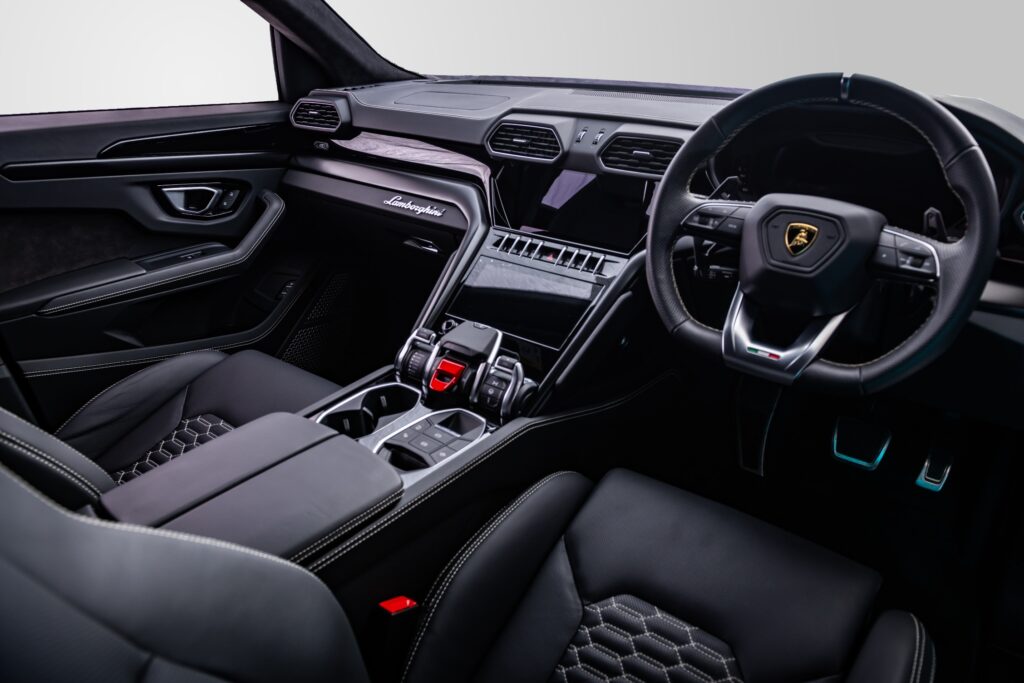
There is the cold weight of a metal paddle shifter under your fingertip, nothing like the plastic stalk in a family saloon. There is the low-frequency rumble at idle, felt in the seat and the sternum before it is heard. There is the sharpened spatial awareness that comes from sitting inches off the road in a car considerably wider than what you are used to, threading it down a country lane where the verges suddenly feel a great deal closer. There is the sound – not the exhaust note alone, but the mechanical chorus underneath it, gear whine and induction noise and the click of paddle shifts, all things a normal commute never lets you hear.
Even the seating position plays a part. Sitting low, with the road rushing past inches from your shoulder rather than several feet below a raised driving position, changes how your brain reads speed altogether – the same 40mph that feels unremarkable in an SUV feels considerably more alive from a cockpit built for a fraction of the ride height. None of this is subtle. It is not meant to be. The sensory intensity is precisely what pulls your attention out of your inbox and into the present moment, because the present moment is, for once, more interesting than whatever is waiting on your phone.
Mental reset for the switched-on
Our clients are disproportionately people who do not get to switch off easily – founders mid-fundraise, executives between meetings, people whose weekends have a habit of quietly filling up with work anyway. For that kind of mind, conventional relaxation often does not land. Lying on a beach with your phone within reach is not a reset. It is just work with a better view, and most people who describe themselves as “bad at relaxing” are not actually bad at it – they have just never been handed a task absorbing enough to make the alternative impossible.
A high-intensity drive works differently because it makes switching off involuntary rather than optional. You cannot think about Monday’s board meeting while you are heel-and-toeing into a hairpin. The demands of the car crowd everything else out, and for the hour or two you are behind the wheel, your usual mental load simply has nowhere to sit. Most of our regular clients say the same thing afterwards, in different words: they feel like they have had a proper weekend, even if the drive itself only took an afternoon.
It is, in a very real sense, mindfulness with a naturally aspirated soundtrack.
Why it beats a normal day off
Conventional downtime tends to fail quietly. You plan a lie-in and end up scrolling. You book a spa day and spend half of it thinking about the email you did not send on Friday. The problem is not the activity – it is that most relaxation leaves just enough spare mental capacity for work to creep back in through the gap.
A supercar day does not leave that gap. There is no spare capacity to fill, because the car is already using it all. That is the entire mechanism behind why an afternoon behind the wheel can leave people more rested than a full weekend spent trying, on paper, to do exactly that.
Trade your routine for a reset
Your ordinary weekend will still be there on Monday. So will the inbox, the group chat and the general noise of being switched on all the time. A few hours in one of our cars will not make any of it disappear – but it will give your head somewhere quiet to go, however loud the engine gets.
Book an Alpha Drive weekend and trade the routine for a genuine sensory reset.